
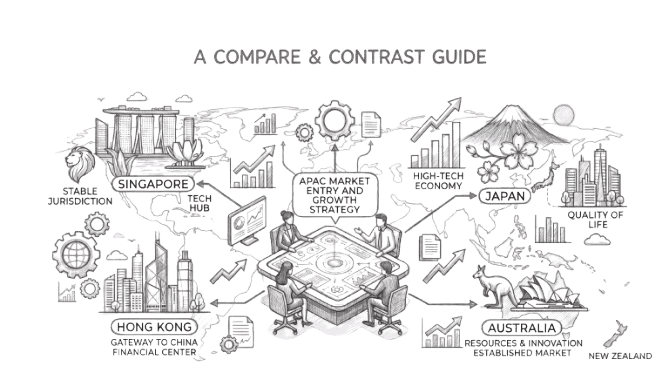
For US companies expanding into Asia-Pacific, the initial decision is where to establish their legal entity. While this may appear straightforward, the implications are significant.
Singapore and Hong Kong are frequently considered as primary options. Australia is often evaluated after legal teams review English-speaking jurisdictions. Japan typically enters the discussion when there is a strong business case that justifies its complexity.
Most expansion playbooks overlook that this decision is not simply a comparison of jurisdictions. It is a matter of sequencing and strategic alignment. The appropriate jurisdiction depends on your industry, target markets, capital structure, and your organization's compliance capacity.
CoverPin’s blog post provides a detailed analysis of entity formation in the four key APAC jurisdictions for US companies: Singapore, Hong Kong, Australia, and Japan. It addresses entity types, formation timelines, ongoing compliance requirements, and critical considerations often overlooked in expansion planning. For organizations seeking a robust international entity structure, this is an essential starting point.
Why APAC Entity Formation Is More Complex Than It Looks
Global expansion may appear straightforward in theory: select a market, register an entity, and begin operations. In practice, the process is significantly more complex.
The Asia-Pacific region comprises multiple sovereign legal systems, each with unique incorporation requirements, tax frameworks, foreign ownership regulations, annual reporting standards, and banking protocols. An entity structure suitable for Singapore may result in unforeseen tax liabilities in Japan. Similarly, an Australian subsidiary that appears efficient may still require Foreign Investment Review Board (FIRB) approval, which can impact timelines and costs.
Successful companies in APAC approach entity formation as the cornerstone of their compliance infrastructure, rather than as a routine administrative task delegated to local providers. This distinction becomes critical when operating in multiple jurisdictions.
Singapore: The Default APAC Hub for Most US Companies
Why Singapore Wins on Setup Speed and Predictability
Singapore is the most straightforward jurisdiction in APAC for foreign companies. The government has invested decades in making market entry frictionless, and it shows.
A private limited company (Pte. Ltd.) can typically be incorporated within one to three business days via the Accounting and Corporate Regulatory Authority (ACRA). There are no foreign ownership restrictions, no minimum capital requirements in practice (though S$1 is the technical floor), and English is the official language of business and government.
The corporate tax rate is 17%, but the effective rate is often lower due to the Tax Exemption Scheme for New Start-Up Companies (which exempts 75% of the first S$100,000 and 50% of the next S$100,000 of chargeable income for the first three Years of Assessment) and the Partial Tax Exemption for established companies. Budget 2026 also introduced a 40% Corporate Income Tax Rebate for Year of Assessment 2026, capped at S$30,000 per company, further reducing the effective rate for the current year. Singapore operates a territorial tax system, meaning that foreign-sourced income is generally not subject to tax unless it is remitted to Singapore under qualifying conditions.
Ongoing Compliance in Singapore
This is where teams often underestimate the workload. Singapore requires:
Annual filing of financial statements with ACRA
Annual general meeting (AGM) or written resolution in lieu
Annual tax return with the Inland Revenue Authority of Singapore (IRAS)
Maintenance of at least one locally resident director
For companies scaling across Southeast Asia, Singapore is a natural regional HQ because of its extensive network of double-tax treaties, ASEAN membership, and proximity to markets such as Indonesia, Vietnam, Malaysia, Thailand, and the Philippines.
A common issue arises when companies prioritize rapid entity formation but underestimate ongoing compliance obligations. Annual filings are mandatory, and the Accounting and Corporate Regulatory Authority (ACRA) imposes penalties for late submissions. Utilizing a registered agent or compliance platform to monitor deadlines is essential for organizations managing multiple entities.
Hong Kong: The Right Choice When China Is in the Picture
Hong Kong's Strategic Position
Hong Kong's value proposition is specific. If your growth roadmap includes mainland China, or if you operate in cross-border finance, trading, or asset management, Hong Kong's positioning is unmatched.
The city operates a territorial tax system with a two-tier profits tax rate: 8.25% on the first HK$2 million of assessable profits and 16.5% on the remainder. Offshore profits may be exempt from tax entirely if properly structured, which creates significant planning opportunities for trading entities and holding companies.
Incorporation is fast, typically one to three business days, with no residency requirement for directors. There are no foreign ownership restrictions and no capital gains tax.
Where Hong Kong Gets Complicated
Hong Kong's Beneficial Ownership Register requirements have tightened significantly. All private companies must maintain a register of significant controllers and make it accessible to law enforcement upon request. This is not a paperwork formality. It requires active maintenance, particularly if your ownership structure changes.
Annual compliance includes:
Filing of annual return with the Companies Registry
Audited financial statements (no small company exemption for foreign-owned entities)
Profits tax return with the Inland Revenue Department
Business registration renewal
The audit requirement distinguishes Hong Kong from Singapore. All Hong Kong companies with corporate ownership must submit audited financial statements annually, irrespective of revenue. Organizations should plan for this requirement from the outset. Failure to implement appropriate accounting infrastructure often results in costly remediation within a short period.
Hong Kong as a Gateway to China
Hong Kong gives foreign-owned companies a practical advantage when establishing a Wholly Foreign-Owned Enterprise (WFOE) in mainland China. The institutional familiarity between Hong Kong and mainland corporate structures, combined with the CEPA (Closer Economic Partnership Arrangement) framework, means Hong Kong-incorporated companies often move faster when entering the Chinese market.
If China is not a near-term market, the strategic advantages of Hong Kong may not be relevant. Organizations should align jurisdiction selection with actual market objectives rather than perceived prestige.
Australia: The Underrated APAC Entry Point for US Companies
Why Australia Gets Overlooked
Australia offers a compelling entry point for US companies due to its English-speaking environment, common law system, political stability, and advanced regulatory framework. Despite these advantages, it is often overlooked in favor of Singapore or Hong Kong, primarily because of perceptions of its geographic position in Asia.
For certain business models, deprioritizing Australia can be a strategic oversight.
Entity Options in Australia
Foreign companies entering Australia choose primarily between:
Australian Proprietary Limited (Pty Ltd): The most common structure for foreign subsidiaries. It provides limited liability, local credibility with banks and regulators, and a clean operational separation from the parent company. This is the default choice for most market entry scenarios.
Registered Foreign Company: This structure registers the foreign parent entity directly with the Australian Securities and Investments Commission (ASIC) without establishing a separate legal entity. While setup is straightforward, it subjects the parent company to Australian compliance requirements and may affect credibility with local stakeholders.
Tax and Compliance in Australia
The standard corporate tax rate is 30%, which is higher than in Singapore or Hong Kong. The small business entity rate of 25% applies to companies with an aggregated annual turnover of less than AUD 50 million. GST applies at 10% if the Australian turnover exceeds AUD 75,000.
Key compliance obligations include:
Annual tax return with the Australian Taxation Office (ATO)
ASIC annual review fee and company statement
Payroll tax compliance at the state level (rates and thresholds vary by state)
Superannuation contributions for employees (currently 12% of ordinary time earnings, effective 1 July 2025, the final scheduled rate increase under current legislation)
Fair Work Act compliance for employment matters
Many US companies are unaware that Australia does not follow at-will employment principles. Terminations require documented procedures under the Fair Work Act, and non-compliance can result in significant penalties. Establishing performance management protocols in advance is recommended.
Foreign investment in Australia may require approval from the Foreign Investment Review Board (FIRB), depending on the sector and transaction value. Transactions cannot proceed until clearance is obtained, which can introduce timeline uncertainty not typically encountered in US domestic transactions.
Australia is an optimal initial APAC market for companies in SaaS, professional services, financial services, and consumer products that require a reliable, English-speaking environment to establish regional product-market fit prior to expanding into more complex jurisdictions.
Japan: High Complexity, High Reward
Japan Requires a Long-Term Commitment
Japan maintains strict adherence to its own processes. For companies seeking only a short-term market test, establishing a full legal entity may be premature. An Employer of Record (EOR) arrangement is often more appropriate until revenue is validated and a long-term strategy is established.
If Japan is a central component of your APAC strategy, the entity structure you establish will determine your credibility with local customers, your ability to recruit senior Japanese talent, and your access to enterprise contracts.
Entity Types in Japan
Japan's Companies Act defines three primary structures for foreign companies:
Kabushiki Kaisha (KK): Japan's equivalent of a corporation. It is the most recognized and trusted structure in the Japanese market, analogous to a C-Corp in the US. KKs can issue shares and are governed by formal corporate governance requirements. The setup process is more rigorous than other types, but signals long-term market commitment. Best for companies pursuing enterprise customers and long-term revenue in Japan.
Godo Kaisha (GK): Functions similarly to a US LLC. It is faster to set up, less expensive to maintain, and appropriate for foreign subsidiaries where speed matters more than ceremony. Non-Japanese companies often choose a GK as a lean market entry vehicle, particularly in technology.
Branch Office: This is not a separate legal entity, and the parent company remains directly liable for all obligations. While setup is expedited, branch offices have reduced credibility with Japanese banks, business partners, and employees. As a result, the use of branch offices is declining due to these practical disadvantages.
Japan's Compliance Realities
Japan requires meticulous attention to corporate governance formalities:
Tax notification to the relevant tax office within three months of incorporation (missing this deadline results in forfeiture of certain tax advantages)
Annual corporate tax filings
Annual reports to the Bank of Japan if foreign ownership exceeds 10%
Business license renewals for regulated industries
While the statutory minimum capital for a KK or GK is ¥1, insufficient capitalization can create challenges with banking relationships and supplier credibility. Most advisors recommend an initial capitalization of ¥5 million to ¥10 million to establish credibility.
Opening a corporate bank account in Japan is challenging for foreign-owned companies due to stringent KYC requirements and the possibility of in-person meetings with bank representatives. Denied applications can have lasting consequences. It is advisable to engage advisors with established banking relationships and a thorough understanding of Japanese bank requirements for foreign-owned entities.
Although Japan eliminated the local director residency requirement in 2016, many banks continue to require a locally resident representative director for account opening. Organizations should incorporate this consideration into their entity planning.
APAC Entity Formation Comparison: At a Glance
Factor | Singapore | Hong Kong | Australia | Japan |
Corporate Tax Rate | 17% (effective lower) | 8.25% / 16.5% | 25-30% | 23.2% national; ~30.6–34.6% effective (incl. local taxes) |
Tax System | Territorial | Territorial | Global (subsidiaries) | Global |
Foreign Ownership | 100% allowed | 100% allowed | 100% allowed (FIRB rules apply) | 100% allowed |
Formation Timeline | 1-3 days | 1-3 days | 1-5 days | 4-8 weeks |
Local Director Required | Yes (resident) | No | Yes (at least 1) | No (but banking expects it) |
Audit Required | Only for larger entities | Yes (foreign-owned) | Yes (above thresholds) | Yes |
Annual Report Filing | Yes | Yes | Yes | Yes |
Best For | Southeast Asia hub, tech, regional HQ | China-facing, financial services, trading | English-speaking market entry, SaaS | Long-term Japan market, enterprise B2B |
Choosing the Right Jurisdiction: The Strategic Decision Tree
The choice of jurisdiction is seldom exclusive. Most organizations expanding into APAC ultimately establish entities in multiple jurisdictions. The order in which jurisdictions are entered is a critical strategic consideration.
Start with Singapore if: Your primary markets are Southeast Asia (Indonesia, Vietnam, Thailand, Malaysia, Philippines), you want to recruit regional talent from a trusted hub, or you need a clean holding structure for APAC operations.
Start with Hong Kong if: China is a near-term revenue target, you are in financial services or asset management, or you have trading operations that benefit from Hong Kong's territorial tax treatment on offshore profits.
Start with Australia if: You are in SaaS, professional services, or consumer products; you want English-language, common law familiarity; and you need a proof-of-concept market before moving into more complex Asian jurisdictions.
Start with Japan if: You have clear product-market fit evidence in Japan specifically, your customer segment is Japanese enterprise or government, and you have the internal bandwidth to manage Japanese compliance rigor over a multi-year horizon.
Managing APAC Entities After Formation: The Compliance Overhead Nobody Talks About
Forming the entity is the beginning, not the end. The compliance obligations that follow are ongoing, jurisdiction-specific, and unforgiving of deadlines.
Across Singapore, Hong Kong, Australia, and Japan, you are typically managing:
Annual report filings with different agencies on different calendars
Corporate tax returns with distinct local requirements
Director and shareholder register maintenance
Business license renewals are tied to your industry and location
Beneficial ownership reporting
Banking relationship maintenance
Changes in registered office or company details
For organizations managing entities in multiple APAC jurisdictions, manual compliance tracking is insufficient. The volume of deadlines, jurisdiction-specific requirements, and the consequences of missed filings, including fines, loss of good standing, and restrictions on major transactions, can escalate rapidly.
Purpose-built entity management software addresses these challenges by enabling proactive compliance management. Organizations can monitor compliance calendars, automate annual report filings, maintain registered agent coverage, and respond to jurisdictional changes before they result in risk.
What Most Expansion Advisors Get Wrong
A few patterns recur in APAC entity formation, particularly for US companies.
Selecting a jurisdiction solely based on headline tax rates is a common error. The effective tax burden is determined by entity structure, treaty access, substance requirements, and transfer pricing considerations. Jurisdictions that appear tax-efficient may create significant exposure if the underlying substance and governance are inadequate.
Bank account opening timelines are frequently underestimated. In Japan, and increasingly in Hong Kong following anti-money laundering reforms, the process can take three to six months. This delay can create a gap between legal formation and operational readiness, affecting hiring, payroll, and vendor relationships.
Failure to plan for ongoing compliance from the outset is a frequent issue. While entity formation is a discrete project, entity maintenance is a continuous operational responsibility. Treating these as equivalent often results in compliance gaps, late filings, and loss of good standing, which can become critical during fundraising, M&A due diligence, or major contract negotiations.
Assuming a single entity structure is suitable for all jurisdictions is a common mistake. Each structure, such as a GK in Japan, Pty Ltd in Australia, Pte. Ltd. in Singapore, and a private limited company in Hong Kong, has distinct governance, filing, and operational requirements. Uniform compliance processes across these jurisdictions can result in errors.
Build Your APAC Entity Strategy on a Solid Compliance Foundation
Expansion into APAC offers significant strategic opportunities for US companies. However, the jurisdictions with the greatest potential also present substantial compliance complexity. Ongoing requirements in Singapore, Hong Kong, Australia, and Japan, including annual filings, audit obligations, employment law, and banking protocols, demand continuous attention beyond initial entity setup.
Organizations that manage this complexity effectively treat international entity management as a core operational function, supported by appropriate infrastructure, rather than as a one-time project delegated to external providers.
CoverPin's entity management platform is designed for this environment. Whether managing a single APAC entity or a global portfolio, CoverPin provides legal and compliance teams with a unified system of record for formations, annual reports, registered agent obligations, and licensing requirements. Automation streamlines compliance coordination, reducing timelines from months to days.
Learn how CoverPin supports international entity management, annual report filings, registered agent services, and compliance advisory for organizations expanding across borders.
To simplify your global compliance infrastructure, schedule a free consultation with our team to review CoverPin's capabilities in practice.
Frequently Asked Questions
Can a US company own 100% of an entity in Singapore, Hong Kong, Australia, or Japan?
Yes. All four jurisdictions allow full foreign ownership without requiring a local shareholder. Australia's Foreign Investment Review Board (FIRB) may require approval depending on the sector and investment value, but the underlying ownership structure itself does not require a mandatory local partner.
How long does entity formation take in each APAC jurisdiction?
Singapore and Hong Kong typically take one to three business days for incorporation. Australia ranges from one to five business days for company registration, though FIRB approval (where required) can extend timelines by months. Japan takes four to eight weeks from start to incorporation, with bank account opening adding three to six additional months in practice.
What is the difference between a registered foreign company and a local subsidiary in Australia?
A registered foreign company is your existing parent entity registered to operate in Australia, making the parent directly liable for Australian obligations. A local subsidiary (Pty Ltd) is a new Australian legal entity, separate from the parent, with its own compliance obligations and liability structure. Most foreign companies choose a Pty Ltd for the cleaner separation and local credibility.
Does Singapore require a local director?
Yes. At least one director of a Singapore-incorporated company must be ordinarily resident in Singapore. This can be a Singaporean citizen, a permanent resident, or an employment pass holder. Many companies appoint a nominee director through a registered service provider to meet this requirement during the initial formation phase.
How does entity management software help with APAC compliance?
Entity management software like CoverPin consolidates compliance calendars across jurisdictions, automates annual report filings, maintains registered agent coverage, tracks director and shareholder data, and surfaces upcoming deadlines before they become emergencies. For companies managing entities across multiple APAC jurisdictions, this eliminates the manual coordination overhead and significantly reduces the risk of missed filings.
What happens if a company misses an annual filing in Hong Kong?
The Companies Registry in Hong Kong can impose fines ranging from HK$300 to HK$100,000 for failure to file annual returns on time. Persistent non-compliance can result in the company being struck off the register, creating significant legal and commercial complications.
Is Japan's Godo Kaisha (GK) or Kabushiki Kaisha (KK) better for a US company entering Japan?
It depends on your timeline and market strategy. A GK is faster and cheaper to set up and maintain, and is often used by foreign subsidiaries and tech companies entering Japan. A KK signals greater commitment and is preferred by Japanese enterprise customers and large employers. If Japan is a strategic, long-term market for your business, invest in the KK from the start.