
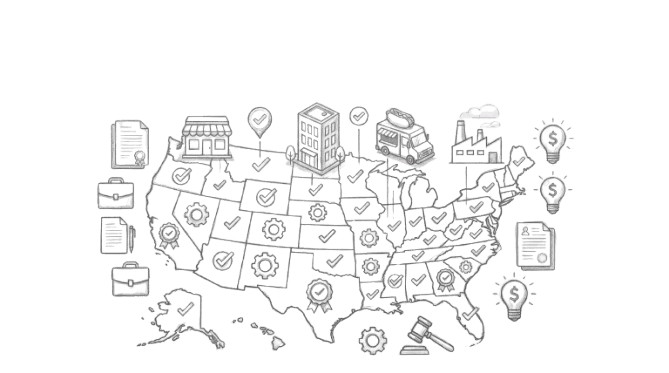
Operating a business across multiple US states requires navigating a landscape where the term “business license” carries different meanings in each jurisdiction. Some states require a general business license from the Secretary of State, others from the Department of Revenue, while certain states impose no state-level requirement but mandate city permits prior to commencing operations. These systems function independently, without coordination between jurisdictions.
Here’s a detailed overview of business licensing in the United States, including the regulatory layers, state-by-state variations, triggers for multi-state requirements, and the consequences of non-compliance. It is intended for organizations that manage entities across multiple jurisdictions or are preparing for expansion.
Why There Is No Single US Business License
There is no universal federal business license in the United States. Instead, licensing is intentionally decentralized, with requirements divided among federal, state, and local authorities. Most businesses must address obligations at all three levels, with the specific requirements determined by industry, entity type, and physical presence.
At the federal level, certain regulated industries require federal licenses or permits before state registration. State-level requirements vary significantly. At the county and city levels, businesses that are compliant at the state level may still encounter additional obligations such as local zoning regulations, home occupation permits, or municipal business tax certificates.
In practice, stating that a business is “licensed” does not provide a complete picture. It is possible for a business to hold all required state licenses while simultaneously operating without the necessary county or municipal authorizations.
The Three Tiers of Business Licensing in the US
Federal Licenses and Permits
Not every business needs a federal license, but if you operate in a federally regulated industry, you cannot skip it. The agencies involved include:
The Alcohol and Tobacco Tax and Trade Bureau (TTB): Manufacturers, importers, and wholesalers of alcohol.
The Federal Aviation Administration (FAA): Aviation-related businesses.
The Drug Enforcement Administration (DEA): Any business handling controlled substances.
The US Fish and Wildlife Service: Wildlife-related commercial activities.
The Federal Communications Commission (FCC): Broadcasting and telecommunications.
The Department of Agriculture (USDA): Interstate transport of animals, plants, and certain food products.
For most non-regulated businesses, the SBA’s federal licenses and permits page is the right starting point to confirm whether federal requirements apply.
State Business Licenses
Every state has its own registration and licensing structure. Some require a general business license issued by the Secretary of State or the Department of Revenue. Others do not have a general business license requirement at the state level, but still require industry-specific permits, professional licenses, or sales tax permits before you can legally operate. California and Florida are two common examples of states where founders assume a statewide license exists, only to discover that the real obligation sits at the city or county level.
Below is an overview of how major states handle general business licensing:
State | General Business License Required | Issuing Agency |
California | No statewide general license; local license required in most cities/counties | City Finance or Revenue Department (plus county agencies for some industries) |
Texas | No statewide general license | Secretary of State (entity registration only) |
Florida | No statewide general license; local Business Tax Receipt required | County Tax Collector / City Revenue Office |
New York | Varies by profession and locality | NY Department of State |
Delaware | Yes (mandatory for all businesses operating in state) | Division of Revenue |
Nevada | Yes (mandatory for all businesses, statewide) | Nevada Secretary of State (plus local municipal permits) |
Wyoming | No statewide general license | Secretary of State (entity registration only) |
Washington | Yes | Department of Revenue (Business License Application) |
A common misconception: Forming an LLC or corporation in a state is equivalent to obtaining a business license. Entity registration provides legal recognition of the business, whereas a business license authorizes specific activities in a defined location. These are distinct processes, frequently managed by separate agencies.
Local Licenses and Permits
Cities and counties add another layer. The most common local requirements include:
General business license or business tax certificate: Required by most cities for any business operating within their limits, even if the business is incorporated elsewhere.
Home occupation permit: Required when a business is operated from a residential address. Many municipalities that do not require licensing for commercial locations still require this.
Zoning and land use permits: Ensure the business's physical location is zoned for its intended use. A retail shop in a light-industrial-zoned area will have problems.
Sign permits: Required in most jurisdictions before installing signage.
Building and occupancy permits: Required when renovating or occupying a commercial space.
Local licensing requirements are often overlooked, especially by businesses entering new markets. State-level compliance does not fulfill local obligations. Local requirements typically involve separate applications, fees, and renewal schedules.
Industry-Specific Licenses: Where Complexity Compounds
Depending on the nature of the business, additional professional or industry-specific licenses may be required in addition to general licensing obligations. These licenses are mandatory and are not transferable between states.
Healthcare: Facility licenses, DEA registrations, and individual professional licenses (physicians, nurses, therapists) all apply. Professional licenses issued in one state are generally not valid in another without a separate application, though interstate compacts are slowly expanding reciprocity.
Construction: Contractor licensing varies enormously. California, Florida, and Nevada have strict state-level contractor licensing requirements that include testing and bonding. Texas requires licensing for certain trades but not for general contractors at the state level. Verification matters.
Food and beverage: Health department permits, food handler certifications, and liquor licenses are required in addition to general business licenses. Restaurants expanding into new cities should initiate the local health permit and liquor license application processes before finalizing lease agreements.
Financial services: State-by-state licensing through the Nationwide Multistate Licensing System (NMLS) is required for mortgage brokers, lenders, and money transmitters. Operating across states means maintaining active licenses in each, with separate renewal timelines and continuing education requirements.
Retail: Seller’s permits, also known as resale certificates or sales tax permits, are required in each state where the business has established a sales tax nexus. Following the Supreme Court’s 2018 South Dakota v. Wayfair decision, economic nexus thresholds allow states to impose licensing obligations based on sales volume, even in the absence of physical presence. Most states set these thresholds at $100,000 in sales or 200 transactions per year.
Multi-State Operations: Where the Real Complexity Begins
Businesses operating in multiple states encounter increased compliance obligations. The primary requirement is foreign entity registration; for example, a business incorporated in Delaware must register as a foreign entity in each state where it conducts business. This registration does not confer a business license but establishes the legal right to operate. Separate licensing processes are required thereafter.
For multi-state businesses, the practical challenges include:
Staggered renewal deadlines. Every state and locality has its own renewal calendar. Annual reports, business license renewals, and permit renewals rarely align. A mid-sized business with 20 locations across 10 states may have 40 to 60 renewal dates spread across the year, each with different filing windows, fee schedules, and supporting documentation requirements.
Changes in personnel or business locations often necessitate new or amended filings. Establishing a new location in a state where the business already operates typically requires additional or updated local permits. Modifications to officers, registered agents, or business addresses may also require state-level filings. These updates are frequently overlooked when compliance is managed manually.
Nexus can arise unexpectedly. For example, an employee working remotely from a state where the business does not otherwise operate can establish a physical presence nexus, resulting in new licensing and tax registration obligations. This scenario has become increasingly common as businesses expand remote workforces without updating compliance protocols.
The consequences of operating without the required licenses are significant. For example, the City of Los Angeles imposes a $250 per day fine for unlicensed operations. Many states have the authority to issue cease-and-desist orders. Additionally, operating without proper licensing can result in voided commercial contracts, invalidated business insurance coverage for incidents occurring during unlicensed periods, and, in some jurisdictions, the inability to pursue legal action to collect unpaid invoices.
How to Identify What Your Business Needs
There is no single database that aggregates every licensing requirement across all US jurisdictions. The process requires checking at three levels for every location:
Start with the SBA: The US Small Business Administration’s licensing and permits tool provides a starting framework organized by state and industry. It links to state agencies but does not comprehensively cover local requirements.
Check your Secretary of State or Department of Revenue: Most states have a business portal or licensing wizard. These vary in quality but are the authoritative source for state-level requirements.
Contact city and county offices directly: Local requirements are the hardest to verify remotely. Many cities do not have comprehensive online resources. For new locations, direct contact with the city clerk or business licensing office is often necessary.
Factor in industry-specific regulators: For regulated professions and industries, the relevant licensing board or state agency takes precedence over general business licensing resources.
Track license renewal dates from the outset. Licenses generally require annual or biennial renewal, and failure to renew on time is typically treated as operating without a license. Establishing a renewal tracking system in advance is recommended.
The Case for Centralizing License Management
Businesses with multiple entities or locations across various states face structural compliance challenges that cannot be effectively managed through spreadsheets or email. The complexity arises from differing agencies, filing formats, renewal schedules, fee structures, documentation requirements, and consequences for non-compliance.
A business license management platform that centralizes these requirements, tracks renewal timelines, and automates reminders significantly reduces the risk of gaps. For companies with registered agents across multiple states, a centralized platform also provides visibility into service of process, annual report deadlines, and entity status in a single view rather than requiring logins to dozens of state portals.
This is precisely what CoverPin is built for. The AI-powered platform handles business license and permit management across all 50 states, tracks renewal calendars automatically, and integrates license management with the broader entity compliance picture: registered agent services, annual report filing, UCC search & filings, and certificate of good standing requests, all in one place.
For businesses expanding internationally, the same compliance principles apply at far higher complexity. CoverPin’s entity management software supports over 90 jurisdictions globally, bringing a centralized approach to formations, dissolutions, and ongoing compliance across markets.
If you are currently managing licenses across multiple states through manual processes, the question is not whether something will fall through the cracks. It is when.
Quick Reference: State-by-State Licensing Resources
Rather than listing 50 static links that change regularly, here is how to find current official resources reliably:
Search: “[State name] business license” site:[state].gov to reach the official portal.
For Secretary of State filings: Search “[State name] Secretary of State business registration.”
For sales tax and seller’s permits: Search “[State name] Department of Revenue seller’s permit.”
For professional licenses: Search “[State name] [profession] licensing board.”
For businesses managing multi-state compliance at scale, CoverPin’s license and permit management service identifies requirements by jurisdiction and industry, handles initial applications, and automatically manages ongoing renewals.
One Last Thing Before You File
Business licensing in the United States is an ongoing compliance obligation involving multiple levels of government, various agencies, and recurring renewal cycles. While businesses with a single location and straightforward structure may find these requirements manageable, organizations with multiple entities, operations in several states, or expansion plans will encounter a significantly increased administrative burden.
Organizations that effectively manage licensing treat it as a structured process rather than an ad hoc task. They maintain clear records of all licenses, track expiration dates, and assign responsibility for each renewal. Achieving this level of visibility requires deliberate planning and systems.
CoverPin’s license and permit filing service and location management platform provides compliance teams with the infrastructure to manage this across all states without building a new internal process from scratch. If your current approach relies on spreadsheets, email reminders, or individual state portal logins, it is worth seeing what a centralized system looks like.
Book a call with the CoverPin team to see how multi-state license management works in practice.
Frequently Asked Questions
Do I need a business license if I only sell online?
Yes, in most cases. Online businesses still have a physical presence (the owner’s location), which creates licensing obligations in that state and potentially in the city or county. If the business reaches sales or transaction thresholds in other states through online sales, economic nexus rules may trigger seller’s permit requirements in those states as well.
Is entity registration the same as a business license?
No. Registering an LLC or corporation with the Secretary of State establishes the legal entity. A business license is a separate authorization to conduct business activities. Most businesses need both, along with any applicable local permits.
How often do business licenses need to be renewed?
Most business licenses renew annually or biannually. Renewal timing and deadlines vary by jurisdiction. Some expire on the anniversary of issuance; others follow a fixed calendar-year cycle. Missing a renewal date typically results in penalties and, in some states, automatic suspension of the license.
What happens if I operate without the required licenses?
Consequences vary by jurisdiction and severity. Common outcomes include fines (sometimes assessed per day of noncompliance), cease-and-desist orders, inability to enforce contracts, voided insurance coverage, and, in some states, loss of the right to collect on unpaid invoices.
What is a foreign entity registration and do I need one?
If your business is incorporated or organized in one state and conducts business in another state, you typically need to register as a foreign entity in the states where you operate. “Conducting business” is broadly defined and generally includes having employees, a physical location, or regular in-state sales activity.
Can a business license management platform handle multi-state filings automatically?
Yes. Platforms like CoverPin centralize license tracking, automate renewal reminders, and manage filings across all 50 states. This is especially valuable for businesses with multiple locations or entities in different jurisdictions, where manual tracking becomes error-prone at scale.
Do I need separate licenses for each business location?
Generally, yes. Each physical location typically requires its own local business license or permit, even if the business entity is the same. State-level licenses may cover all in-state locations in some cases, but local requirements are almost always location-specific.