
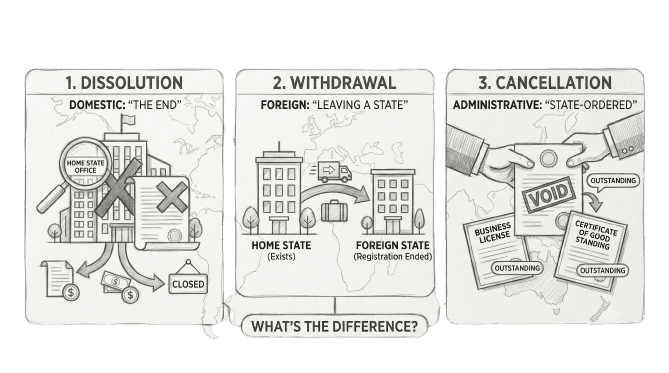
When a business ceases operations in a state or closes entirely, three terms often arise: dissolution, withdrawal, and cancellation. These terms are frequently used interchangeably, but they have distinct legal meanings. Applying the incorrect process can result in ongoing legal exposure for your business.
Let’s break down the meaning of each term, outline when each applies, detail the required processes, and address the consequences of failing to complete the necessary steps.
Why These Three Terms Get Confused (and Why It Matters)
The confusion is understandable because states use varying terminology. For example, California refers to certain filings as a Certificate of Cancellation, while Texas issues a Certificate of Withdrawal of Registration. Some states use the term "termination" instead of "dissolution". For partnerships, cancellation is often the correct term, whereas dissolution typically applies to corporations and LLCs.
The consequences of using the wrong process are significant. If you discontinue operations in a state without filing the appropriate paperwork, the state will continue to consider your business active. This results in ongoing obligations, including annual reports, franchise taxes, and registered agent fees. In certain states, officers and directors may be held personally liable for unpaid taxes and fees that accrue after business operations have ceased, even if the entity remains open in state records.
Complying with these requirements is not a technicality; it is a legal and financial obligation for every business.
What Is Entity Dissolution?
Dissolution is the process of permanently terminating a business entity's legal existence in the state in which it was formed, also called its domestic state or home state.
Dissolving an entity notifies the state that the business has ceased to exist. Once dissolution is approved, the entity no longer has legal standing. It cannot enter into contracts, hold assets, or incur new liabilities. All business activities are formally concluded.
Dissolution is filed with the state where the entity was originally formed, typically through the Secretary of State's office. The document is usually called the Articles of Dissolution, the Certificate of Dissolution, or the Certificate of Termination, depending on the state.
Voluntary vs. Involuntary Dissolution
Voluntary dissolution happens when the owners, shareholders, or members of an entity decide to close the business. This requires a formal vote or consent according to the entity's governing documents, followed by state filings.
Involuntary dissolution, also known as administrative dissolution, occurs when the state initiates the process due to a business's failure to meet compliance obligations. Missing annual reports, failing to maintain a registered agent, or accumulating unpaid franchise taxes can all result in administrative dissolution. This process may occur without the business's knowledge or consent and can create significant challenges, especially if the business is still operating.
What the Dissolution Process Looks Like
The full dissolution process typically involves:
Internal authorization: a vote of shareholders, members, or partners approving the closure.
Winding up operations: notifying creditors, settling debts, liquidating assets, and distributing remaining assets to owners.
Canceling licenses and permits: business licenses, local permits, and professional registrations do not automatically terminate when a business closes.
Closing tax accounts: filing final state and federal tax returns, canceling payroll accounts, and, in many states, obtaining a tax clearance certificate before the state will approve the dissolution.
Filing with the Secretary of State: submitting the Articles of Dissolution and any required attachments.
Withdrawing from foreign states.
Many businesses are unaware that several states require tax clearance before processing a dissolution filing. Obtaining tax clearance can extend the timeline by several weeks or months, especially if there are outstanding tax obligations that must be resolved first.
If you are managing multiple entities or multi-state operations, CoverPin's dissolution and withdrawal service handles the full process, including tax clearance coordination, across all required jurisdictions.
What Is Entity Withdrawal?
Withdrawal is a much more limited action than dissolution. It applies specifically to foreign qualifications, which are the registrations a business files to legally operate in a state other than its home state.
A Delaware-registered company that registers to do business in California has a foreign qualification in California. Withdrawal is the process of ending that California registration, without affecting the entity's existence or its registration in any other state.
When you withdraw a foreign qualification, you are saying that “we” are no longer conducting business in this state. The entity itself continues to exist and can remain active everywhere else it operates.
When Do You Need to Withdraw?
You need to file a withdrawal if your business:
Has stopped conducting business in a particular state but remains active in its home state or other states.
Is scaling back multi-state operations to a smaller footprint.
Has completed a project in a state where it was temporarily qualified.
Is restructuring and consolidating its registered presence.
If your business has stopped operating in a state but has not filed a withdrawal, you remain legally responsible for annual report filings, franchise taxes, and registered agent fees in that state. Many businesses only become aware of these obligations when they receive collection notices years after ceasing operations.
What Withdrawal Actually Requires
Withdrawal filings typically require:
Confirmation that the entity has ceased conducting business in the state.
Evidence that all outstanding annual reports and taxes in that state are current.
In some states, a tax clearance certificate is required from the state revenue authority.
The correct form for the entity type and state varies considerably. A foreign LLC and a foreign corporation may file different documents even in the same state.
The document name also varies: Certificate of Withdrawal, Application for Withdrawal, Certificate of Surrender (for California corporations), or Application for Termination of Registration, depending on the jurisdiction and entity type.
Maintaining a registered agent in each state where you are qualified is required until withdrawal is formally approved. This is worth factoring into the timeline.
What Is Cancellation?
Cancellation is most commonly used in two specific contexts.
First, many states use "cancellation" to describe the dissolution of a limited partnership (LP) or limited liability partnership (LLP). In these cases, cancellation is functionally equivalent to dissolution for corporations and LLCs. It permanently ends the entity's legal existence in its home state.
Second, some states use "cancellation" to refer to the termination of a foreign LLC's registration, whereas others use "withdrawal." California is a notable example: a foreign LLC in California files a Certificate of Cancellation to end its registration, while a foreign corporation files a Certificate of Surrender.
The distinction is important because submitting the incorrect document can result in rejection, delays, and missed deadlines, which may lead to additional penalties.
For practical purposes, if you are dealing with a limited partnership or an LLP, "cancellation" is the term you are looking for. If you are dealing with an LLC or corporation and the question is whether to end its existence entirely or just its registration in a particular state, the same dissolution vs. withdrawal analysis applies.
Dissolution vs. Withdrawal vs. Cancellation: Side-by-Side Comparison
Feature | Dissolution | Withdrawl | Cancellation |
What it does | Permanently ends the entity's legal existence | Ends registration in a foreign (non-home) state | Ends entity existence (LPs/LLPs) or foreign registration (some states) |
Filed where | Home/domestic state | Foreign-qualified state | Home state (for LPs/LLPs) or foreign state (state-specific) |
Entity continues after? | No | Yes | No (for domestic) |
Triggers | Business closing entirely | Leaving a state, an entity remains active elsewhere | Partnership/LLP closing, or per state terminology |
Common documents | Articles of Dissolution, Certificate of Termination | Certificate of Withdrawal, Application for Withdrawal | Certificate of Cancellation |
Tax clearance required? | Often yes | Sometimes | Often yes |
Annual report obligations end? | Yes, upon approval | Yes, in that state only | Yes, upon approval |
What Order Should You File In? (Multi-State Businesses)
For businesses registered in multiple states, the correct sequence matters. Filing in the wrong order can complicate or invalidate subsequent filings.
The standard approach is:
Withdraw from all foreign states first. End the foreign qualifications in every state where the entity is registered but was not formed.
Dissolve in the home state. Once foreign withdrawals are complete, file dissolution in the state of formation.
A common misconception is that withdrawal occurs automatically after dissolution is filed. In reality, foreign states will continue to treat the entity as active and assess fees until a formal withdrawal filing is submitted.
The reverse situation also occurs. Some businesses dissolve in their home state but fail to withdraw from foreign states. These states are not notified of the dissolution and continue to issue annual report notices and franchise tax bills. Resolving this issue often requires reinstating the entity in the home state, completing the necessary withdrawals, and then dissolving the entity again.
CoverPin's entity management platform tracks all state registrations in one place, so nothing gets missed when a wind-down begins.
The Most Common Mistakes and Their Consequences
Omitting the formal process entirely is a common mistake. Some business owners cease operations and assume the state will recognize this change. However, states do not close entities automatically unless prompted by compliance failures. Even administrative dissolution does not eliminate tax obligations, and personal liability exposure remains.
Neglecting to address foreign states is another frequent error. Businesses registered in multiple states must file in each jurisdiction. Failing to do so results in continued fees and legal exposure in any state where the process is incomplete.
Filing for dissolution before completing withdrawals can complicate the process in foreign states. These states may require proof that the entity is still active in its home state. If the entity has already been dissolved, additional steps may be necessary to complete the withdrawal.
Overlooking tax clearance requirements is a common issue. Several states will not accept a dissolution filing without a tax clearance certificate from the Department of Revenue. Submitting a filing without this certificate results in rejection and delays the process.
Allowing annual reports to lapse during the wind-down process can create additional challenges. If annual reports are not filed, many states require the entity to be brought back into good standing before processing the dissolution, which increases both cost and time.
Staying current with annual report filings and maintaining a certificate of good standing throughout the wind-down process avoids these setbacks.
How Entity Management Software Simplifies This Process
Managing dissolution, withdrawal, and cancellation across multiple states is operationally intensive. Each state has its own forms, timelines, tax clearance rules, publication requirements, and registered agent obligations. Tracking all of this manually across even three or four states creates a real risk of missing a step.
Entity management software centralizes this. CoverPin maintains a live record of every state registration, filing deadline, and compliance obligation for your entities. When a wind-down begins, the system identifies which states require withdrawals, which require tax clearance first, and the correct filing sequence, without your team having to research each state from scratch.
For organizations managing dozens or hundreds of entities across jurisdictions, this is the difference between a clean exit and a years-long tail of unexpected fees, notices, and liability exposure.
Bottom Line
Dissolution, withdrawal, and cancellation each fulfill a specific role in the entity lifecycle. Using the incorrect process or omitting required steps creates legal and financial risks that may persist long after business operations have ended.
The fundamental rule is clear: dissolve in the home state to terminate the entity's existence, withdraw from foreign jurisdictions to end registration there, and use the correct terminology, such as "cancellation," for limited partnerships or in states with unique naming conventions.
For businesses with operations in multiple states, the complexity increases significantly. Ensuring the correct sequence, obtaining necessary tax clearances, and submitting accurate filings in each jurisdiction requires careful coordination and knowledge of state-specific requirements.
CoverPin manages the entire dissolution and withdrawal process across all 50 states and international jurisdictions. If your business is winding down operations in a single state or closing entirely, our service oversees every step, from obtaining tax clearance to submitting final state filings, ensuring complete compliance.
Have questions? Book a call with our compliance team to understand how our AI-powered platform can help.
Frequently Asked Questions
What is the difference between dissolution and withdrawal?
Dissolution permanently ends a business entity's legal existence in its home state. Withdrawal removes a business's registration from a state where it was qualified to do business but was not formed. After withdrawal, the entity continues to exist and operate elsewhere.
What does cancellation mean for a business entity?
Cancellation typically refers to the formal closure of a limited partnership or limited liability partnership, equivalent to dissolution for LLCs and corporations. Some states also use "cancellation" instead of "withdrawal" for ending a foreign LLC's registration in their state.
Do I need to withdraw from foreign states before dissolving?
Yes, in most cases. The recommended sequence is to withdraw from all foreign-qualified states first, then dissolve in the home state. Dissolving first can complicate foreign withdrawals.
What happens if I don't formally dissolve or withdraw?
Your business remains legally active in the state's records. Annual report obligations, franchise taxes, and registered agent fees continue to accumulate. In some states, officers and directors can be held personally liable for these unpaid obligations.
Does tax clearance apply to both dissolution and withdrawal?
It depends on the state. Many states require tax clearance for dissolution. Some states also require it for withdrawal. Requirements vary significantly by jurisdiction and entity type.
Can I dissolve an entity that is not in good standing?
Some states require you to first bring the entity back into good standing (by filing any missed annual reports and paying any outstanding fees) before they will accept a dissolution filing. Others allow simultaneous filing.
How long does the dissolution process take?
Timelines vary by state, ranging from a few days to several months. States with mandatory tax clearance requirements add the most time to the process.
What is administrative dissolution?
Administrative dissolution is an involuntary action taken by the state when a business fails to meet its compliance obligations, such as filing annual reports or maintaining a registered agent. The business is dissolved without the owners having initiated or approved it.