

Entity management is a risk item for every company, but low on the urgency items, which is exactly why most companies overpay for it. The Google data center playbook shows what happens when you question comfortable defaults. Internationally, it gets worse.
Google runs its data centers hot. While most enterprise operators keep server rooms between 68°F and 77°F out of engineering conservatism, Google pushes well past that, operating at approximately 80°F as a baseline and running facilities like the one in St. Ghislain, Belgium, as high as 95°F. Hot aisles in those environments approach 120°F. Staff cannot work there for extended periods.
The rationale is ruthlessly simple: raising ambient temperature by a single degree can reduce cooling costs by up to 4%. Over thousands of square feet of compute, which compounds fast. Google didn't accept the default. They stress-tested it. They asked: What actually breaks if we push this? And they found the answer was: not much, if you design for it.
If the risk is low and the cost is high, you don't maintain the status quo. You interrogate it.
THE GOOGLE THERMAL PROFILE
Traditional data center range | 68F to 77F (20C to 25C) |
Google standard operating temp | ~80F (27C) |
St. Ghislain, Belgium (peak) | 95F (35C) |
Hot aisle exhaust temp | ~120F (49C) |
Cooling savings per degree increase | ~4% |
Now take that logic and apply it somewhere most legal and operations teams have never thought to apply it: entity management.
What actually drives entity management?
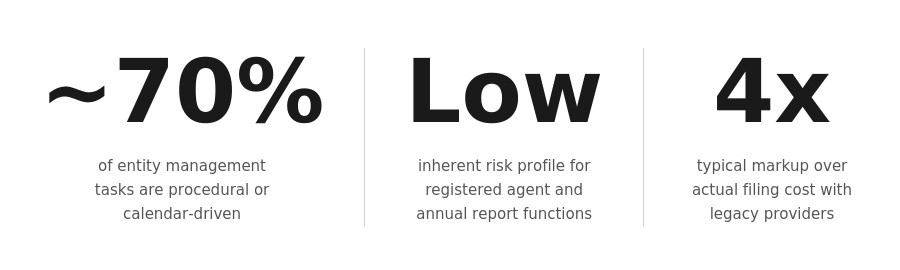
Entity management is not a legal-first function. Strip away the professional mystique, and what remains is largely a tax and operations matter. Registered agent designations, annual report filings, and certificates of good standing are administrative checkboxes. Compliance deadlines are known. Consequences of failure are generally curable with a late fee. This is not litigation risk. It is not regulatory exposure. It is calendar management with legal dressing.
And yet the market has treated it like a premium legal service for decades. A handful of registered agent providers have built substantial businesses on that perception, packaging a filing function inside enterprise contracts priced at multiples of what the underlying work actually costs.
THE QUESTION COMPANIES ARE NOT ASKING
If the risk profile is low and the function is largely procedural, why is entity management not subject to the same cost-efficiency pressures as other administrative overhead? The Google thermal test applies: what actually breaks if you move away from the legacy provider?
International Operations: Where it gets structural
If domestic entity management is expensive for what it is, international entity management is a different category of problem, and a much more defensible one to challenge.
A company operating across ten or fifteen jurisdictions is rarely working with one provider. They are managing five or six simultaneously: one for APAC, one for EMEA, one for Latin America, one inherited from an acquisition, and one recommended by outside counsel three years ago. Each relationship has its own pricing, its own portal, its own contact, its own response latency. The managed service provider in the middle, often the legacy brand on the contract, is not doing the work. They are coordinating it. They are the inbox between the client and the local agent on the ground who actually touches the filing.
The managed service provider doesn't have visibility. The local provider does. Every leg between the client and the source is a markup with no added value.
The Coordination Tax

This chain is not a feature. It is a cost structure that compounds at every handoff. And critically, visibility lives at the end of it, with the local provider. When something goes wrong, when a deadline is missed, when a document is incorrect, the client is three relationships away from anyone who actually knows what happened.
The standard explanation for why international entity management is expensive is the complexity of local government. Every jurisdiction has its own rules, its own language, its own filing cadence. That is true. But it is not the whole story, and the industry has benefited enormously from the assumption that it is. The local government is not the one adding the markup. The chain is.
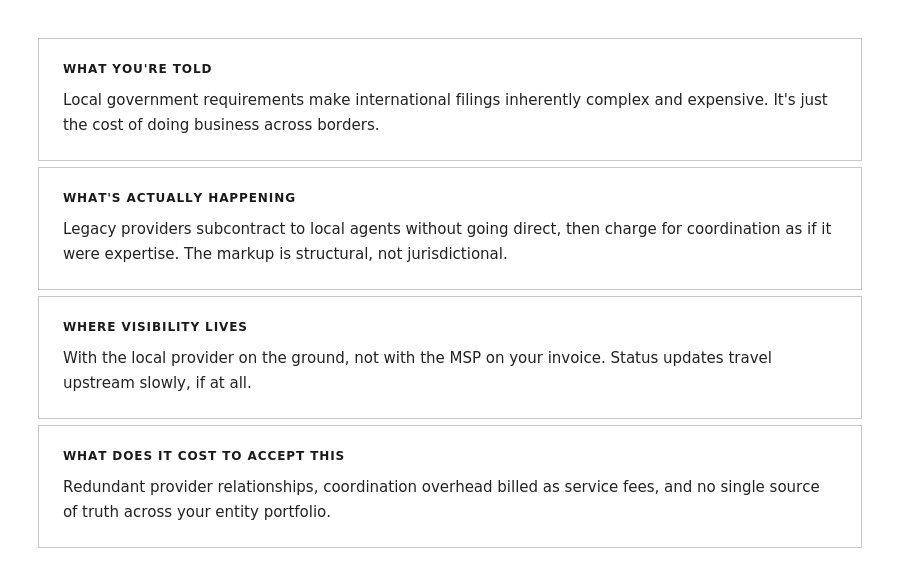
The genuine complexity of foreign jurisdictions is real. But complexity is not the same as opacity. And opacity is what legacy providers sell, whether intentionally or not. When the client cannot see the local agent, cannot benchmark local filing costs, and cannot measure what coordination actually contributes, the price is whatever the MSP decides it is.
Stress Testing the Default
Stress testing is not about finding ways to fail. It is about proving that the system is more resilient than you assumed, or exposing that it is less so. For international entity management, the stress test is pointed: what does local filing actually cost when you go directly to the source? What portion of your current spend is coordination overhead? How many providers could be collapsed into a single platform with direct local relationships?
The answers are more comfortable than most legal and ops teams expect. Jurisdictional complexity is a real constraint, but it is one that modern platforms, with direct local networks and AI-driven workflow automation, are purpose-built to absorb. The coordination layer that consumes margin and obscures visibility is not a necessary feature of international compliance. It is a legacy architecture.
Companies don't overpay for international entity management because it's complex. They overpay because no one traced the money back to where the work actually happens.
The Cost of Comfortable Defaults
Google's thermal insight was not just about cooling efficiency. It was a signal about institutional risk tolerance versus institutional habit. Most data centers ran at 68°F because that was the assumed safe zone, not because anyone had empirically validated that warmer couldn't work. The cost of that comfort was a significant efficiency premium paid year over year, at scale.
Entity management, domestic and international, carries exactly the same dynamic. The function is low urgency. The risk is manageable. The cost is high and largely opaque. And the architecture underneath it, particularly across borders, is built for the provider's convenience, not the client's visibility.
The prescription is not to abandon rigor. It is to apply appropriate rigor. Map your current provider landscape. Trace what each leg costs and what each leg contributes. Ask whether you have visibility, or whether you have a managed service provider who has visibility on your behalf, and charges you for the privilege of not having it yourself.
When Entity Management Actually Becomes a Risk
Entity management earns its low spot on the risk register precisely because the failure mode is entirely predictable and entirely avoidable. Miss a filing, stop paying your franchise tax, ignore a Statement of Information deadline, and the state does not warn you gently. In California, the Franchise Tax Board suspends your business. Full stop.
A suspended business loses its rights, powers, and privileges to do business in the state. Specifically, you cannot:
Legally transact or do business
Sell, transfer, or exchange real property
Bring an action or defend your business in court
Legally close or dissolve the entity
Enforce contracts signed while suspended (the other party can void them)
Protect your right to use your business name. The Secretary of State can deny your revivor request if the name has been taken in the interim
The financial exposure compounds quickly:
$2,000 penalty per tax year for failing to file missing returns within 60 days of a written demand
Personal liability if the business cannot pay, specifically if you took assets out of the business, had unpaid loans to shareholders, or paid excessive salaries to officers
What triggers all of this is equally simple. Failure to file a return, or failure to pay taxes, penalties, fees, or interest. The Secretary of State will separately suspend you for missing a Statement of Information.
The point is not that entity management is complicated. It is that the consequences of neglecting it are disproportionate to the effort required to avoid them. File on schedule. File accurate information. That is the entire job. The risk only materializes when someone stops doing the easiest part of corporate administration.
The Bottom Line
Entity management is a check-the-box function priced like a strategic legal service, and internationally, it is a coordination tax stacked on top of a coordination tax. The risk profile does not justify the spend. The provider landscape does not justify the opacity. And the local government, which everyone reflexively blames, is not the one adding the markup. Google proved you can run a lot hotter than conventional wisdom assumes. The same is true of your entity management budget.