

Managing a single entity within one state is relatively simple. You file the annual report, maintain a registered agent, and fulfill basic requirements. However, as soon as your business operates in multiple states or expands internationally, compliance obligations become significantly more complex.
Each jurisdiction has its own deadlines, registered agent requirements, UCC lien schedules, business license renewal requirements, and tax registration obligations. As your business expands, these requirements multiply and become increasingly difficult to manage. Many organizations attempt to address this complexity with spreadsheets, calendar reminders, and multiple service vendors. This approach is often sufficient until a critical deadline is missed or a compliance failure occurs.
A modern entity management software like CoverPin is designed to address these challenges at scale. This post outlines the core functions of such platforms, distinguishes modern solutions from outdated systems, and provides a framework for evaluating options when managing compliance across multiple states or jurisdictions.
What Entity Management Software Actually Does
Entity management software centralizes the full lifecycle of legal entities, including formation, ongoing compliance, and dissolution. It consolidates essential data and workflows that legal and compliance teams depend on to maintain operational integrity.
The core functions most platforms cover include:
Tracking entity details: formation dates, jurisdictions, registration numbers, and entity status
Registered agent records are tied directly to entity data
Annual report deadlines with automated tracking and filing
UCC lien schedules and filing management
Business license inventories linked to specific locations and entity types
Officer and director registers
Real-time good standing status across every jurisdiction
Not all platforms address every function, and even fewer provide effective solutions for both domestic and international operations. Defining your specific compliance requirements before evaluating software options is essential to avoid unnecessary delays and inefficiencies.
Why Compliance Complexity Scales Faster Than Most Teams Expect
Compliance professionals frequently observe a common pattern: a company forms in Delaware, expands to additional states, and initially manages each new jurisdiction with relative ease. However, as operations extend to eight or ten states, the compliance burden often exceeds internal capacity. Missing a single filing in a state such as California or Texas can result in late fees, loss of good standing, or even administrative dissolution.
Several structural forces are making this problem more acute with time:
Regulatory Enforcement Has Tightened
States are enforcing annual report and registered agent requirements with greater rigor. Administrative dissolution is now a practical risk for expanding companies. The expenses associated with correcting compliance failures, reinstating entities, and resolving transactions during a lapse routinely exceed the cost of maintaining compliance from the outset.
Global Portfolios Have Become Standard
Private equity firms, multinational corporations, and growth-stage companies now routinely operate across dozens of jurisdictions. A platform limited to U.S. states does not provide complete coverage for these organizations. The compliance frameworks in EU member states, the UK, and markets in the Middle East and Africa each add their own requirements.
Legal Operations Teams Are Running Leaner
Automation has become essential for compliance teams managing large entity portfolios across multiple states. Manual tracking at this scale exposes organizations to audit risks and diverts resources from more strategic activities.
UCC Secured Lending Has Grown More Complex
Complex financing arrangements, including SaaS collateral and cross-border asset-based lending, heighten the risk of UCC filing errors. Missed continuations or incorrect amendments can result in significant financial consequences for both lenders and borrowers. Reliance on basic calendar reminders is insufficient to manage these obligations effectively.
The Features That Separate Modern Platforms from Legacy Software
Most vendors present similar claims regarding centralized data, automated reminders, and deadline tracking. In practice, platforms differ significantly in the extent to which they automate compliance tasks versus simply providing visibility into obligations.
True Automation vs. Compliance Calendars
There is a critical distinction between software that issues filing reminders and software that completes filings on your behalf. Effective entity management platforms automate execution rather than relying solely on notifications. If your team continues to enter data manually after receiving reminders, the solution functions as a compliance calendar rather than a comprehensive management tool. It is important to confirm whether a platform automates filings or merely alerts users to upcoming deadlines.
Integrated Registered Agent Services
Every state mandates a registered agent with a physical address to receive legal and government correspondence. Engaging separate vendors in each state, without integrating with your entity records, creates compliance gaps that can expose your organization to significant risk. If service of process is received by a vendor who is not connected to your compliance system, critical notices may be missed, potentially resulting in default judgments.
CoverPin's registered agent service covers all 50 U.S. states and integrates directly into each entity record, eliminating the vendor coordination problem that plagues multi-state businesses using fragmented service providers.
Jurisdiction Coverage That Matches Your Actual Operations
A platform offering comprehensive U.S. coverage must support all 50 states with built-in, state-specific rules. Requirements such as Delaware franchise tax calculations, California's biennial Statement of Information, and Florida's annual report fee structures differ significantly and are subject to change. Your compliance team should not be required to research these independently or rely on generic reminders that lack jurisdiction-specific guidance.
For organizations operating globally, the requirement is more demanding. Each EU member state has its own company law requirements. Beneficial ownership disclosure under frameworks like the EU AML directives varies by country and continues to evolve. An entity management platform that cannot handle this complexity does not actually serve global operations.
UCC Search and Filing as Part of the Core Platform
Legacy systems often manage UCC filings separately from entity compliance, creating data silos that increase organizational risk. A lender's secured position relies on accurate and timely UCC-1 financing statements. When amendments, continuations, and terminations must be completed on schedule, disconnected workflows are inadequate.
CoverPin handles UCC searches and filings as part of its core platform, not as a separate service requiring a separate login or vendor relationship. You can view UCC filing status alongside entity records and compliance obligations in a single system.
Business License and Permit Management
Business license compliance is often the most fragmented aspect of an organization's compliance operations. Requirements differ by state, county, city, and business type. Renewal schedules rarely align with fiscal years or annual report deadlines. Operating without a required license in certain jurisdictions can result in penalties beyond standard late fees.
A capable platform identifies what your business needs based on location, entity type, and industry, then manages renewals proactively. CoverPin links license requirements to tax registrations, entity records, and certificates of insurance, providing visibility that most businesses lack when these functions are managed separately.
Commercial Insurance as a Compliance Function
Commercial insurance is often viewed separately from entity management, but for organizations with multiple entities and locations, it is a critical component. Certificate of insurance requirements linked to contracts, jurisdictional coverage thresholds, and renewal cycles that must align with entity and license compliance all directly impact the level of protection across your business operations.
CoverPin integrates commercial insurance management into its platform, allowing businesses to lower premiums and manage coverage alongside entity and license compliance rather than maintaining a separate workflow.
Annual Reports Across All Jurisdictions
Annual report filings are a leading cause of compliance failures for businesses operating in multiple states. Due dates differ by state and entity type. Fee calculations may be based on authorized shares, revenue thresholds, or flat rates, and each jurisdiction requires distinct forms and filing processes.
CoverPin auto-files annual reports, keeping entity records synced with government sources rather than relying on manual data entry or email-based coordination with external vendors.
Evaluating Entity Management Software for Global Operations
If your operations extend beyond the United States, the evaluation framework becomes more specific.
Local expertise at the jurisdiction level: Software that supports global entity management needs built-in knowledge of jurisdiction-specific requirements, not just deadline tracking.
Beneficial ownership compliance: With the U.S. Corporate Transparency Act in effect and EU UBO frameworks expanding, managing and disclosing beneficial ownership data is a live obligation. Your platform needs auditable records of ownership structures across all operating jurisdictions.
Data governance and security: Global compliance requires handling sensitive corporate information across multiple legal systems. Enterprise-grade security, role-based access, and clear data processing agreements are baseline requirements.
Tax registration integration: VAT, GST, sales tax, and withholding tax registrations are tied directly to the locations where you have established entities. A platform that handles entity management but does not address tax registration creates a gap.
CoverPin's global platform covers entity formation and dissolution, registered agent services in international markets, tax registration across VAT, GST, and sales tax regimes, and license management for businesses operating outside the United States.
Entity Formation and Dissolution: Managing the Full Lifecycle
While ongoing maintenance receives significant attention, proper entity formation and dissolution are equally critical and are often overlooked or mishandled.
Entity formation must occur in the appropriate jurisdiction, with the correct structure and registered agent designation from the outset. Errors in formation documents can result in issues that require substantial time and legal resources to resolve.
A foreign qualification is required when you conduct business in a state where your entity was not formed. The threshold for what constitutes doing business varies by state, and getting it wrong can carry retroactive penalties.
Dissolution is often postponed or neglected when businesses exit a market or undergo restructuring. Entities that are not formally dissolved continue to incur compliance obligations, late fees, and registered agent expenses. In certain jurisdictions, failure to dissolve can also result in ongoing personal liability for officers and directors.
CoverPin manages the full entity lifecycle, including formation, foreign qualification, amendments, mergers, and dissolution across U.S. states and internationally.
Certificate of Good Standing: Why It Matters More Than Most Businesses Realize
A certificate of good standing is a state-issued document confirming that your entity is in compliance with that state's requirements. You need one to open a business bank account, close a financing transaction, execute certain contracts, or register in a new state.
Good standing status can lapse rapidly if annual reports are missed or registered agent services are not maintained. When a certificate of good standing is required, organizations may need to resolve compliance failures first, which can delay critical transactions.
Maintaining good standing proactively across all active jurisdictions is one of the most compelling reasons to use entity management software. CoverPin provides real-time good-standing status and can issue certificates of good standing on demand.
Why More Compliance Teams Are Moving Beyond Legacy Entity Management Software
Legacy software set the standard. CoverPin raises it.
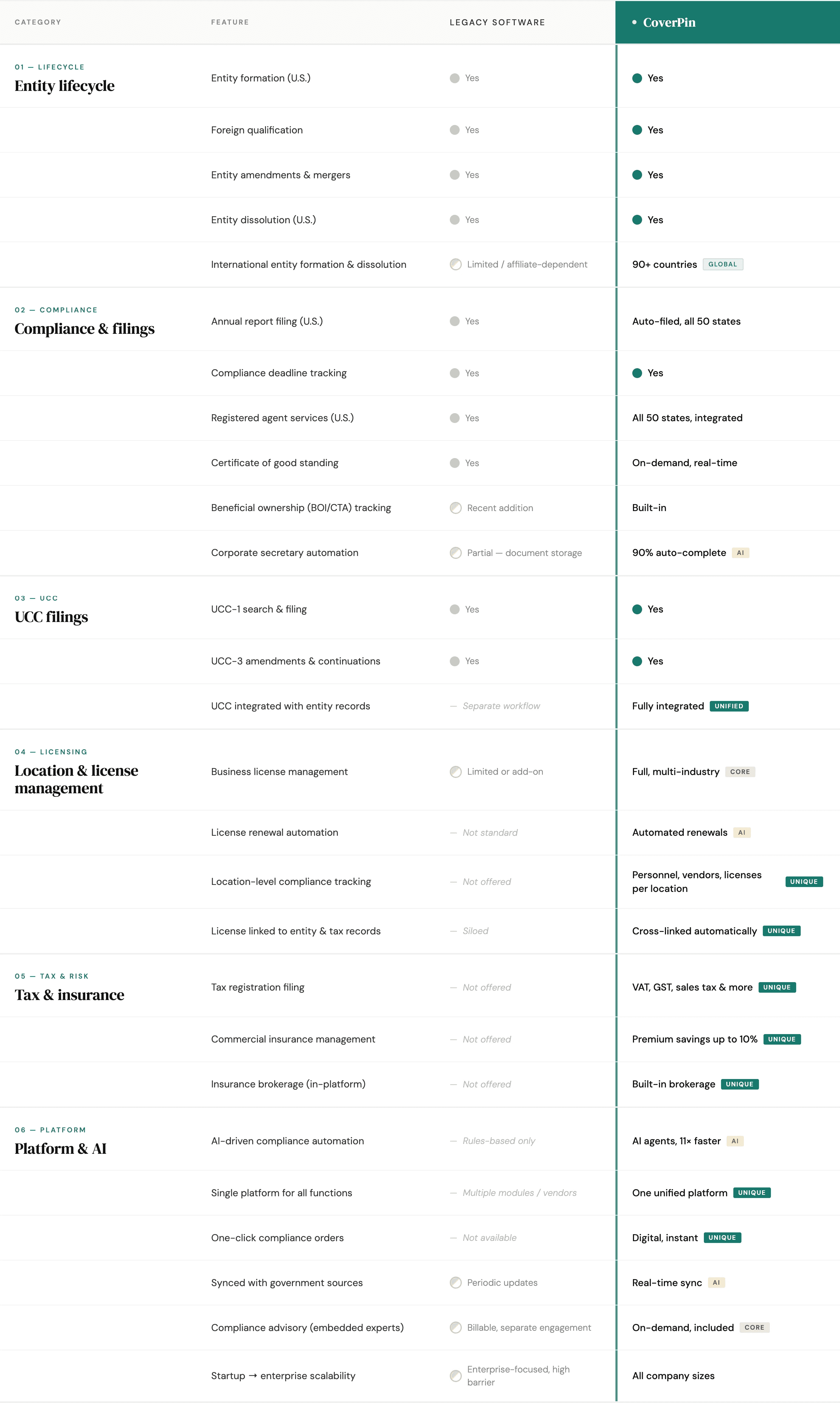
Legacy platforms were built for a different era of corporate compliance: one where large legal teams managed entities manually, vendors handled each function separately, and "automation" meant a deadline reminder in your inbox. For their time, they were category-defining.
The compliance environment in 2026 is fundamentally different. Businesses expand across state lines more rapidly, and global operations are now common among organizations of all sizes. Legal operations teams are leaner and face increased expectations. The financial and operational consequences of missed filings, lapsed licenses, or uninsured locations have also increased.
Legacy platforms cover the fundamentals well: entity formation, registered agent services, UCC filings, annual reports, and good standing tracking. CoverPin covers all of that, too. The difference is everything that comes after.
Integrated business license management, location-specific compliance tracking, commercial insurance administration, and automation that executes compliance tasks rather than simply issuing reminders are now essential features. These capabilities represent a fundamental shift in what organizations should expect from a compliance platform.
How CoverPin Approaches Entity Management Differently
Most entity management platforms were built for a specific use case: either law firms managing client portfolios, or enterprise legal departments maintaining complex subsidiary structures. The workflows, pricing models, and feature sets reflect those origins.
CoverPin was built for the way modern businesses actually operate: across multiple states, often across borders, with teams that need compliance to happen automatically rather than requiring constant oversight. The platform covers entity management, location management, license and permit management, UCC searches and filings, registered agent services, commercial insurance, annual reports, certificates of good standing, tax filings, and compliance advisory in a single system.
Instead of relying on manual coordination among multiple vendors, a unified platform enables seamless data integration. Changes to entity information automatically update license and permit records. Registered agent modifications are reflected in entity records, and annual report filings synchronize good standing status in real time.
Organizations that previously managed compliance with legacy software, outside counsel, and spreadsheets will experience substantial operational improvements. Tasks that once required extensive email correspondence and weeks of coordination can now be completed with a single compliance order, automated processing, and real-time status updates.
If your current compliance processes require more coordination than actual execution, it is important to evaluate the practical benefits of a unified platform.
Book a demo with CoverPin to see how the platform handles your specific entity portfolio, jurisdictions, and compliance obligations.
FAQ
What is entity management software?
Entity management software is a centralized platform for tracking, maintaining, and managing legal entities across their full lifecycle. It handles compliance obligations, including annual reports, registered agent services, UCC filings, business licenses, and good-standing status across multiple states or countries.
What is the difference between entity management software and compliance software?
The terms are often used interchangeably, but entity management software specifically focuses on the corporate record and lifecycle of legal entities. Compliance software is a broader category that can include HR compliance, regulatory compliance, and quality management. For businesses managing multiple legal entities across jurisdictions, entity management software addresses the core operational need.
How do I know if my business needs entity management software?
If you are operating in more than two or three states, managing more than a handful of legal entities, or expanding internationally, manual tracking typically breaks down. The clearest signal is when compliance failures start occurring: missed annual reports, lapsed good standing, or late UCC continuations. At that point, the cost of the software is smaller than the cost of the failures it prevents.
Does entity management software handle international compliance?
Many platforms handle U.S. compliance only. Platforms built for global operations need to manage jurisdiction-specific requirements, beneficial ownership disclosure, local entity types, and tax registrations across multiple countries. CoverPin's platform covers global entity management, including formation, dissolution, registered agent services, and tax compliance, across markets outside the United States.
How does CoverPin handle UCC filings?
CoverPin manages UCC-1 financing statement filings, amendments, continuations, and terminations as part of its core platform. UCC filing status is tracked alongside entity records and registered agent information, rather than requiring a separate workflow and vendor.
Can entity management software help reduce insurance costs?
CoverPin's platform integrates commercial insurance management and has helped businesses lower premiums by coordinating coverage across entities and locations. When insurance is treated as part of your compliance posture rather than a separate administrative function, there are opportunities to optimize coverage and reduce overall costs.