
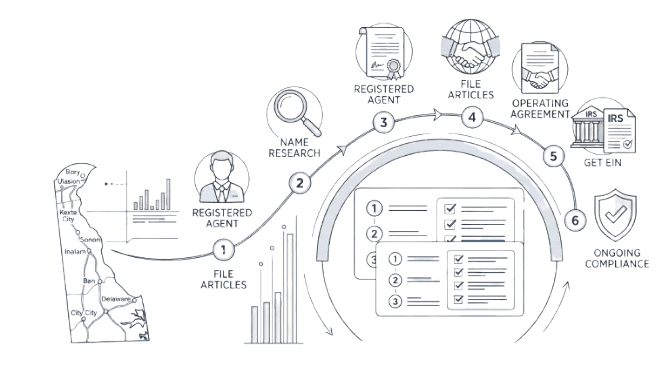
Delaware has more businesses than residents. Over 60% of Fortune 500 companies are incorporated there. The state sets the standard for venture-backed companies and is known for its business-friendly legal environment, refined over the course of decades.
Forming a Delaware LLC is only the first step. Many guides focus on filing the Certificate of Formation but neglect ongoing compliance, multi-state obligations, and franchise tax deadlines. These are the common causes of compliance failures.
Let’s first cover how to form a Delaware LLC in 2026. Then, we'll walk through the associated costs, followed by a detailed look at the steps needed to remain legally compliant and maintain good standing.
Why Delaware? What Makes It the Default Choice
Most states allow LLCs, but Delaware offers a legal framework built for business.
The Court of Chancery Advantage
The Court of Chancery is a specialized business court where judges, not juries, decide cases. These judges have deep experience in corporate law. The court's consistent, predictable rulings provide a stable setting for resolving investor, ownership, and governance disputes.
Privacy, Tax, and Flexibility
Delaware does not require the names of members or managers on the Certificate of Formation, keeping ownership details private. LLCs that do not operate in Delaware avoid state income and sales taxes. The flat $300 annual franchise tax makes compliance simple.
Delaware's LLC statute is flexible. Founders and investors have broad discretion in structuring operating agreements, governance, economic terms, and exits. Key takeaway: Delaware’s flexibility in LLC statutes allows you to customize your company’s structure to suit your needs.
Step 1: Choose and Reserve Your LLC Name
Your LLC name must be unique in Delaware and include "Limited Liability Company," "LLC," or "L.L.C." Check name availability for free at the Delaware Division of Corporations before filing.
A few naming restrictions apply. You cannot use words that imply government affiliation (FBI, Treasury, State Department). Words like "bank," "trust," or "insurance" require additional state approval. Restricted professional terms such as "attorney" or "university" may require a licensed individual to be part of your LLC.
If you're not ready to file, Delaware allows a 120-day name reservation for $75. Most businesses file soon after confirming availability.
Verify your desired domain name is available before finalizing your LLC name. Take this step to avoid future legal and operational complications.
Step 2: Appoint a Delaware Registered Agent
Every Delaware LLC must have a registered agent with a physical street address in Delaware. P.O. boxes don't qualify. The registered agent accepts legal and tax documents for your LLC.
Who Qualifies as a Registered Agent in Delaware
You can serve as your own registered agent if you have a Delaware address and are available during normal business hours. Most founders can't meet this because they don't live in Delaware.
DIY vs. Professional Service: The Real Trade-off
Serving as your own registered agent puts your personal address in public records, and all legal notices are sent there. Professional services provide a Delaware address, maintain business hours, and forward correspondence. Most businesses use professional agents to protect privacy and avoid missed notices.
CoverPin's registered agent service provides unlimited service of process across all 50 states, so you never miss a notice regardless of where your operations expand.
Step 3: File Your Certificate of Formation
The Certificate of Formation legally creates your LLC and is filed with the Delaware Division of Corporations.
What the Certificate of Formation Requires
Delaware keeps this form simple. List your LLC name, Delaware registered agent's name and address, and an authorized signature. You don't list members, managers, or ownership percentages in this public document.
Filing Fees and Processing Times
The filing fee for the Certificate of Formation is $90. Standard processing takes 10–15 business days. Expedited options are available: same-day for $100 more, or 24-hour processing for an additional fee.
File online through Delaware's portal for faster processing and confirmation. Mail-in filing is also available to Dover.
Step 4: Draft Your Operating Agreement
Delaware does not require you to file an operating agreement, but having one is essential.
Draft a detailed operating agreement describing ownership percentages, profit and loss distribution, decision-making, and member exit procedures. Take control of your LLC's internal governance and avoid default rules that may not fit your needs.
Prepare your operating agreement in advance. You will need it to open a business bank account and present to investors. Use it to facilitate member dispute resolution. Key takeaway: An operating agreement is critical for banking, investment, and resolving internal issues.
Delaware's Court of Chancery gives legal weight to operating agreements, which is a key reason many choose Delaware.
Step 5: Obtain an EIN from the IRS
An Employer Identification Number (EIN) from the IRS is required to open a business bank account, hire employees, and file taxes. Single-member LLCs benefit from having an EIN to keep Social Security numbers off business documents.
Apply for a free EIN at IRS.gov. US residents can get it online in 10 minutes.
Special Instructions for Non-US Residents
If you are a non-US resident without a US Social Security number or ITIN, you cannot use the online EIN application. You may fax IRS Form SS-4 (within 4–10 days), mail it (about 4 weeks), or call the IRS to get your EIN. A formation service experienced with international founders can help.
Step 6: Open a Business Bank Account
Keep a separate business bank account to preserve your LLC's liability protection. Mixing business and personal funds can result in a loss of protection during litigation. Key takeaway: Always keep business and personal finances separate to protect against liability.
Gather your Certificate of Formation, EIN, operating agreement, and government-issued ID to open a business bank account. Visit the bank in person if required, especially if you are a non-US resident.
Step 7: Register for Taxes If You Operate in Delaware
If your LLC is formed in Delaware but operates in another state, you do not owe Delaware income tax. Delaware does not tax out-of-state LLC income. Non-residents pay tax where they live and work.
Start at Delaware One Stop to register your LLC, obtain licenses, and set up state tax. Secure a Delaware Business License to do business in Delaware.
The Part Every Guide Skips: Keeping Your Delaware LLC Alive
Formation is one event; compliance is ongoing. Many guides skip these requirements, risking problems for owners. Long-term compliance is essential to prevent penalties or loss of your LLC.
Annual Franchise Tax: $300, Due June 1, Every Year
Every Delaware LLC pays a $300 franchise tax each year, due June 1. No annual report is required for LLCs, unlike corporations.
Missing the tax deadline brings a $200 penalty and 1.5% monthly interest. Non-payment results in cancellation, and resolving it requires paying all overdue taxes, penalties, interest, and fees. Liability protection is lost upon cancellation.
CoverPin's annual report filing service tracks and auto-files these obligations so the June 1 deadline never becomes a risk event on your calendar.
Beneficial Ownership Information (BOI) Reporting
The Corporate Transparency Act required BOI reporting for most US LLCs beginning in 2024. In March 2025, FinCEN exempted domestic US entities; if your LLC is formed in the US, you do not need to file a BOI report now.
This exemption is not permanent law. FinCEN is expected to finalize the rule this year, and the regulatory landscape could shift. Foreign-formed entities registered to do business in the US still have active BOI obligations. We recommend monitoring FinCEN guidance at fincen.gov and consulting a compliance advisor before assuming this exemption will remain in place in the long term.
Foreign Qualification: When You Operate in Other States
Forming an LLC in Delaware does not grant the legal right to conduct business in other states. If your LLC has employees, offices, a physical presence, or conducts regular business transactions in another state, you must foreign qualify in that state.
Foreign qualification involves registering as a foreign LLC with the target state's business authority, appointing a registered agent in that state, and paying that state's registration and ongoing fees. Each state has its own definition of "doing business" and its own fee structure. Getting this wrong exposes you to back taxes, penalties, and the inability to sue in that state's courts.
For companies operating in multiple states, compliance requirements increase significantly. Each state has its own registered agent requirements, annual report schedule, and fee structure.
Multi-State Compliance and What It Really Costs
The administrative burden of multi-state compliance is substantial and frequently underestimated. Annual report deadlines vary by state. Some states assess franchise taxes based on revenue, while others assess them based on authorized shares. Officer disclosure requirements also differ by jurisdiction.
Many growing companies operate in multiple states before establishing adequate internal compliance infrastructure. Missing an annual report filing can result in loss of good standing, which may prevent the company from closing transactions, securing financing, or renewing contracts.
You can obtain your current compliance status at any time by requesting a Certificate of Good Standing from each state where you are registered. As part of due diligence, investors and acquirers will ask for them.
How to Manage Delaware LLC Compliance at Scale
As a company expands, manual compliance management becomes increasingly difficult. Many organizations only become aware of compliance gaps after missing a filing, receiving a lapsed registered agent notice, or failing to complete a required foreign qualification.
CoverPin's entity management platform centralizes your entire compliance portfolio: registered agent services, annual report auto-filing, entity formations and dissolutions, UCC filings, business licenses, and commercial insurance, all in one system across all 50 states and 90+ jurisdictions globally. What typically requires 40+ emails, multiple vendor relationships, and weeks of coordination is reduced to a single dashboard.
To properly close a Delaware LLC, you must file a Certificate of Cancellation with the state, resolve all outstanding tax obligations, and formally withdraw from any states where the LLC is foreign qualified. CoverPin's dissolution and withdrawal service manages this process to ensure compliance and prevent ongoing liability for fees and penalties.
Effective compliance programs treat entity management as a core operational function. The consequences of non-compliance, such as dissolution during fundraising or foreign qualification gaps identified in due diligence, typically exceed the cost of maintaining proper compliance.
Ready to move past formation and into full-scale compliance? CoverPin automates registered agent services, annual filings, entity formations, and multi-state license management across all 50 states and 90+ jurisdictions globally. Request a free demo to see how it works.
Frequently Asked Questions
How much does it cost to form an LLC in Delaware in 2026?
The state filing fee for a Certificate of Formation is $90. Expedited same-day processing costs an additional $100. You will also need a registered agent (typically $50-$300 per year, depending on the service). Every Delaware LLC owes a $300 annual franchise tax due on June 1 each year.
Do I need to live in Delaware to form a Delaware LLC?
No. You can form a Delaware LLC from any state or country. You do not need a Delaware address as long as you appoint a registered agent with a physical address in Delaware. This is exactly why Delaware is popular with non-US residents and founders based in other states.
Can a non-US resident form a Delaware LLC?
Yes. Non-US residents can form a Delaware LLC without restriction. The main differences are the EIN application process (which must be submitted by fax, mail, or phone rather than online) and opening a US business bank account (which may require a US address or an in-person visit, depending on the bank).
What happens if I miss the Delaware annual franchise tax deadline?
Delaware adds a $200 late penalty immediately on June 2, plus 1.5% monthly interest on the unpaid amount. Continued non-payment results in the administrative cancellation of your LLC, which removes your liability protection and makes your name available to others.
Does forming an LLC in Delaware mean I only pay taxes in Delaware?
No. If you operate in other states, those states may require you to qualify as a foreign entity and pay their taxes and fees as well. Delaware does not tax out-of-state income at the LLC level, but your obligations in other states depend on where you actually conduct business.
What is the difference between forming in Delaware and foreign qualifying?
Formation creates your entity in Delaware. Foreign qualification registers your Delaware LLC to conduct business legally in another state. They are separate processes with separate fees in each state.
Do I need an operating agreement for my Delaware LLC?
Delaware technically requires LLCs to have an operating agreement under the LLC Act, though it need not be filed with the state. From a practical standpoint, you need one to open a bank account, close a funding round, and protect your liability shield in the event of a dispute.
What is the BOI report, and do I need to file one for my Delaware LLC?
The Beneficial Ownership Information report is a filing required by FinCEN under the Corporate Transparency Act. Most Delaware LLCs must file it. LLCs formed in 2025 or later must file within 30 days of formation. Penalties for non-compliance are severe: up to $591 per day in civil penalties and criminal charges for willful violations.