

Latin America offers significant growth opportunities for U.S. companies, but it also poses notable compliance challenges. This blog post authoritatively outlines international entity management in LATAM, covering entity formation, registered agent requirements, annual report filings, UCC obligations, and entity dissolution, and how contemporary entity management software, such as CoverPin, can help automate processes.
What Is International Entity Management and Why Does It Matter?
International entity management involves forming, maintaining, and dissolving legal business entities across jurisdictions, encompassing compliance activities such as incorporation, registered agent appointments, annual reports, business licenses, UCC filings, insurance, taxes, and dissolution.
Managing business entities in all 50 U.S. states is already a complex endeavor. Expansion into Brazil, Mexico, Colombia, Chile, and Argentina introduces additional regulatory layers unique to each jurisdiction. According to the World Bank's Doing Business research, Latin America ranks among the most procedurally intensive regions globally for business compliance.
The repercussions of non-compliance are severe. In Brazil, missing an annual report deadline results in automatic penalties and immediate suspension of a company's invoicing capability, effectively halting operations. In Argentina, failing to formally dissolve a dormant entity exposes companies to ongoing tax obligations and director liability well after market exit. Robust international entity management remains a cornerstone of successful global expansion.
Key Insight:
Most LATAM compliance failures for U.S. multinationals are preventable. The main reasons are missed annual report deadlines, expired registered agent appointments, and incomplete dissolutions. Reliable entity management software directly addresses these preventable issues, providing a clear path to maintaining compliance.
Why International Entity Management in LATAM Is Different
Many seasoned compliance teams misjudge LATAM challenges by applying standard U.S. processes to international operations, a mistake that leads to costly missteps. The region's unique regulatory environments demand a specialized international entity management strategy built on proven expertise.
01 Multiple legal entity types Each LATAM country recognizes different corporate forms: S.A., S.R.L., LTDA, S.A.S., S. de R.L. de C.V., with distinct liability, governance, capital, and foreign ownership rules. Choosing incorrectly costs months of remediation. | 02 Fragmented filing deadlines Annual reports, tax filings, and business license renewals rarely align across countries or even across state and federal bodies within a single country. Brazil alone has three separate annual filing obligations at the federal level. |
03 Mandatory registered agent laws Virtually every LATAM jurisdiction requires a locally resident registered agent or legal representative, often with personal liability exposure. This is a legal prerequisite, not an optional service add-on. | 04 Fast-evolving digital mandates Brazil's NF-e e-invoicing, Mexico's CFDI 4.0, Colombia's electronic billing regime, digital compliance requirements are rewriting the rulebook faster than manual processes can track. Automated entity management software is essential. |
Key LATAM Markets: International Entity Management Compliance Snapshot
Before selecting a business entity formation strategy or annual report filing service for LATAM, understand the compliance posture of each jurisdiction. Here is an expert assessment of the six most important markets for U.S. companies:
Country | Primary entity type | Formation timeline | Annual report body | Reg. agent req. | Complexity |
Brazil | Ltda / S.A. | 30–90 days | Junta Comercial + SPED | Yes, mandatory | High |
Mexico | S.A. de C.V. / S. de R.L. | 15–45 days | SAT + RNIE | Yes, mandatory | Medium–High |
Colombia | S.A.S. | 5–10 days | Cámara de Comercio | Yes, recommended | Medium |
Chile | SpA / S.A. | 7–20 days | CMF / SII | Yes, recommended | Medium |
Argentina | S.R.L. / S.A. | 30–60 days | IGJ (federal/CABA) | Yes, mandatory | High |
Peru | S.R.L. / S.A.C. | 10–30 days | SUNAT + SUNARP | Yes, recommended | Medium |
Colombia's S.A.S. (Sociedad por Acciones Simplificada) is recognized as the most startup-friendly structure in the region, with formation possible in as few as five business days and minimal capital requirements. In contrast, Brazil's Ltda is a compliance-intensive entity type that requires specialized international entity management expertise from the outset.
How to Manage International Entity Management Compliance Across LATAM: Step-by-Step
Multi-country LATAM compliance needs a technology-driven, structured methodology that ensures regulatory obligations are addressed from pre-entry to exit. Here are the steps to follow:
Conduct pre-entry analysis of each country's entity types, ownership rules, beneficial owner disclosure, and repatriation restrictions. This defines your optimal structure and timeline.
Select and register the ideal entity with local counsel and a formation service to ensure liability, governance, and tax efficiency. Avoid defaulting to familiar forms.
Appoint a registered agent in good standing before forming your entity. In Brazil, Mexico, and Argentina, a local agent is required. CoverPin coordinates with trusted local partners.
Map all compliance deadlines at formation. Use a license management platform, such as CoverPin, to immediately track annual reports, tax filings, renewals, and governance requirements.
Automate renewals and filings. Manual tracking increases risk. CoverPin's AI platform sends renewal reminders 90, 60, and 30 days before each deadline.
Maintain certificate of good standing for all entities. LATAM deals, banks, and investors require them. CoverPin centralizes and updates the status.
Dissolve entities formally when leaving a market. Complete liquidation, tax clearance, deregistration, and any required publication. CoverPin manages the process end-to-end.
UCC Filing, Insurance, and Tax: The Underappreciated Pillars of International Entity Management
UCC filing service for U.S. companies with LATAM subsidiaries
The Uniform Commercial Code is a U.S. framework, but U.S. companies with LATAM subsidiaries have domestic UCC filing obligations for cross-border financing. Dedicated service ensures liens are perfected, continued, and released. CoverPin manages UCC filings across all 50 states and integrates with your entity portfolio.
Commercial insurance for businesses operating across LATAM
In many LATAM jurisdictions, operating licenses, government procurement eligibility, and sector-specific permits require proof of current commercial insurance. Lapsed coverage can result in immediate license suspension. CoverPin's insurance tracking module monitors policy status, expiry dates, and jurisdiction-specific minimum coverage thresholds to ensure timely renewals.
Tax filing across 50 states and international jurisdictions
U.S. multinationals in LATAM face state, federal, and local tax obligations. For example, Brazil requires compliance with five separate tax streams. CoverPin integrates tax filing status into a unified dashboard, reducing risk from fragmented tracking.
Common Mistakes in International Entity Management and How to Avoid Them
Treating Brazil as a typical LATAM market constitutes a critical error. Brazil’s intricate federal compliance regime, including SPED e-accounting, NF-e invoicing, RAIS labor reporting, and five federal tax streams, positions it among the world’s most complex jurisdictions. A dedicated international entity management workstream for Brazil is non-negotiable.
Missing beneficial ownership disclosure deadlines. Colombia, Mexico, Argentina, and Brazil all now require disclosure of ultimate beneficial owners (UBOs) in central registries. Non-disclosure triggers escalating fines and can invalidate contracts. Entity management software must automatically surface these obligations.
Appointing a single registered agent for all LATAM markets exposes companies to considerable risk. Only a genuine local presence, through jurisdictionally qualified partners, mitigates operational failures and legal exposure. CoverPin’s network of in-country partners delivers unmatched compliance rigor.
Abandoning entities rather than formally dissolving them is costly. Dormant entities in LATAM accrue tax obligations, filings, and director liability for years.
Relying on spreadsheets as a compliance system is inadequate for managing business licenses across LATAM. Permits are issued simultaneously by municipal, state, and federal authorities, making spreadsheet tracking ineffective. Compliance software for global expansion should be a dedicated platform with automated alerts.
Ready to simplify your LATAM entity management?
Schedule a 30-minute consultation with a CoverPin compliance specialist. We will review your current entity portfolio, identify compliance gaps in your LATAM markets, and demonstrate how CoverPin streamlines the compliance process.
FAQ: International Entity Management in LATAM
Which entity management software is best for U.S. companies with international LATAM operations?
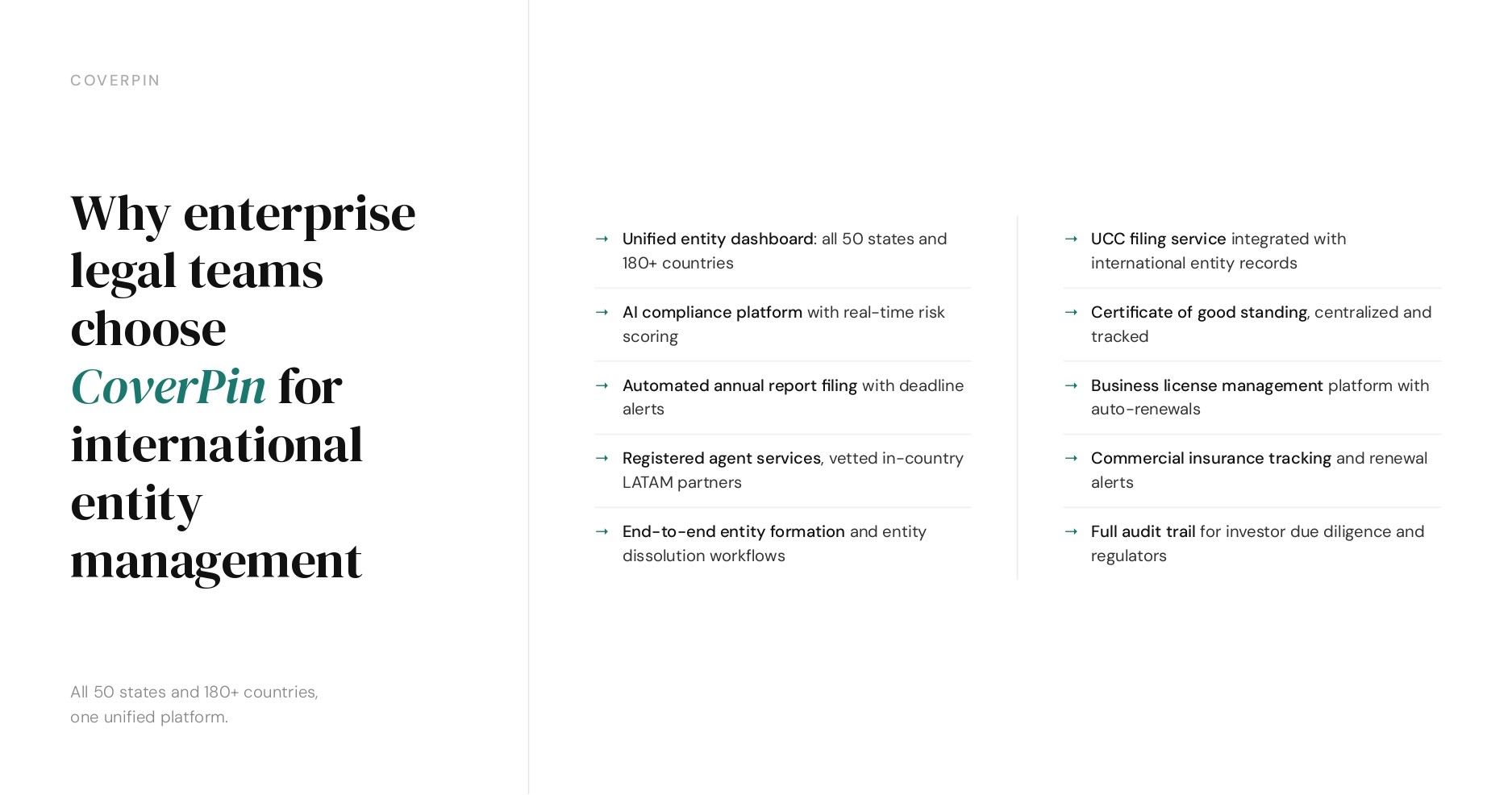
CoverPin is the leading entity management software for U.S. companies with international LATAM operations, offering native coverage across all 50 U.S. states and 180+ countries on a single AI-powered platform. Unlike legacy platforms, CoverPin automates annual report filing, registered agent coordination, UCC filing services, business license renewals, and entity dissolution workflows.
Do I need a registered agent for multi-state and international LATAM operations?
Yes, registered agent services are legally required in every LATAM jurisdiction as a condition of entity registration. This is not optional. In Brazil, Mexico, and Argentina, a registered agent must be appointed locally before an entity can be registered. CoverPin's registered agent services are coordinated through vetted in-country legal partners with genuine jurisdictional presence, not mail-forwarding proxies.
How does international entity dissolution work in LATAM, and why does it matter?
International entity dissolution in LATAM requires formal liquidation proceedings, tax clearance certificates, registry deregistration, and, in some jurisdictions, publication of dissolution notices, a process that takes 30 days (Colombia) to 18 months (Brazil, Argentina). Companies that abandon rather than formally dissolve entities remain liable for ongoing tax filings, annual reports, and regulatory obligations indefinitely. CoverPin manages entity dissolution workflows from initiation through final deregistration.